Your First Shabbat Dinner: What to Expect and What to Bring
Invited to your first Shabbat dinner? What to bring, what to wear, the order of the evening from a guest's seat, and the etiquette questions everyone quietly has.

HBayit Community
You have been invited to a Shabbat dinner, and somewhere under the “yes, lovely, thank you” is a quieter question: what actually happens at one of these? If you did not grow up with it, or grew up with a very different version back in Israel, Friday night in a London home can feel like a room where everyone knows the choreography except you.
Here is the short version of the background. A Shabbat dinner is the Friday-night meal that opens Shabbat, the Jewish day of rest. That is genuinely all you need in order to walk in. If you want the fuller picture, the food and how to put one on yourself, that lives in our guide to what a Shabbat dinner is and how to host one. This page is the guest’s version: what to bring, what happens when, and the questions people are too polite to ask out loud.
What to bring to a Shabbat dinner
Bringing something small is a lovely habit rather than an obligation, and there are only a few things you need to know.
- Wine is the default. A bottle of red is the classic. Grape juice is a genuinely useful alternative if there will be children or drivers at the table.
- Flowers work anywhere. They also solve the problem of a host who does not drink.
- Dessert is the third safe answer. A box from a bakery, good fruit, a babka. Something that needs no oven and no plating.
- Ask before you bring a dish. A main course arriving unannounced can quietly wreck a menu built around courses. A quick “what can I bring that works for your table?” solves it.
- On kosher, just ask. Kitchens differ from home to home, and hosts are used to the question. Sealed wine, flowers and fruit are almost always fine.
What to wear
- Smart-casual is right almost everywhere. A nice shirt, a simple dress, decent jeans if the rest of you is tidy.
- Most people dress a notch up. Not because anyone requires it, but because marking the end of the week is half the point of the evening.
- More traditional homes lean slightly more formal. If your host’s table is one you cannot read from the invitation, ask. It is a five-second question.
- Assume you will be sitting for hours. Comfort beats sharpness by the time dessert arrives.
The order of the evening, from a guest’s seat
Every home does it slightly differently, but the shape is remarkably consistent, and once you have seen it once it stops being mysterious. Here it is with your part in it.
- You arrive and hand over what you brought. A “Shabbat shalom” at the door is the standard greeting, and it comes back to you the same way. Expect a drink and standing-up conversation while the last people turn up.
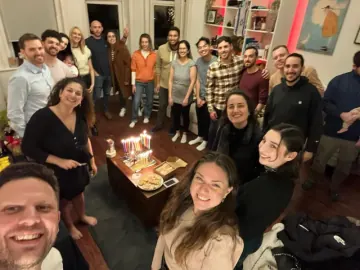
- Candles. Two candles are lit, usually by the host, to mark the start of Shabbat. It takes a moment, the room goes quiet, and you simply watch.
- Kiddush, the blessing over wine. Somebody says or sings a short blessing over wine or grape juice. You may be handed a glass, or the same cup may be shared around. Listening is enough, and “amen” at the end is optional.
- Challah, the blessing over the bread. A blessing is said over two plaited loaves, which are then torn or sliced, often dipped in a little salt, and passed around. A piece will reach you. This is the moment everyone has been waiting for, because it means the food is starting.
- The meal. Salatim first, usually, then soup or straight to the main. Take a little of everything early rather than filling your plate, because more keeps coming.
- Lingering. Tea, dessert, more talking, sometimes singing. This part often runs longer than the meal itself.
- Leaving. People go in ones and twos once things have wound down. Thank whoever cooked on your way out.
If you would like to know what is arriving and in what order, the menu course by course is set out in our guide.
The table rituals explained, simply
None of the small rituals ask anything of you, and it helps to know what each one is for.
- The candles mark time. They separate the ordinary week from the evening you are about to spend, and they are the signal to slow down.
- The wine blessing (Kiddush) sets the meal apart from an ordinary dinner. Think of it as the toast that opens the evening.
- The bread blessing (Hamotzi) is a short thank-you before eating. The loaf is plaited and slightly sweet, and there are traditionally two of them on the table.
- The salt on the bread is an old custom, one of those details that carries a lot of history and asks nothing of a first-timer.
- Handwashing happens at some tables before the bread, often in a quiet, wordless way. If you see people stepping to the sink, you can follow or stay seated. Both are normal.
- Singing (zmirot) turns up between courses at more traditional tables. Nobody is auditioning, and humming counts.
Think of all of it as tradition being shared with you. You are being shown something, and the whole point of showing it is that you enjoy the evening.
Shabbat dinner etiquette: the questions everyone quietly has
The questions nobody likes to ask out loud, answered plainly.
- Can I use my phone? In more traditional homes phones are set aside for the evening, which is honestly part of the charm. A glance at the room when you arrive tells you the tone. If in doubt, keep it in your pocket.
- Where do I sit? Wait to be placed if there is any hint of a seating plan, which there often is at a full table. Hosts tend to seat newcomers deliberately, next to people who will talk to them.
- Should I offer to help? Yes, and expect to be turned down twice before being handed a bowl. Clearing plates between courses is always welcome.
- When do I leave? Whenever feels natural once the meal has wound down. Leaving early is unremarkable, and so is staying until the kettle goes on for the third time.
- What if I get a blessing wrong or say nothing at all? Then nothing happens. Hosts genuinely enjoy folding a newcomer in, and everyone at that table learned this by watching somebody else do it.
Once you have been to a few, the natural next step is setting your own table, which is much less work than it looks from a guest’s chair. Our guide covers the menu and how to host from scratch.
Finding a table when nobody has invited you yet
If you have just landed and do not know many people, a Shabbat table is one of the easiest ways into the community, and you do not have to wait to be asked. For 8+ years we have run open-door Friday-night dinners of exactly the come-as-you-are kind: social, unpretentious, and full of people who arrived here the same way you did.
Our guide to Friday-night dinner in London explains how ours work and how to grab a seat, and there is more of what the community runs through the year in our guide to Jewish and Israeli events in London. The next few dates always sit on our events page. If you are still in the box-unpacking stage of all this, our guide to moving to London covers the rest of the landing.
A first Shabbat dinner is really just a warm meal with new people, wrapped in a few gentle customs. Say yes, bring a bottle, and let the evening unfold. Someone at that table was a first-timer once too.
Common questions
What should I bring to a Shabbat dinner?
A bottle of wine, a bunch of flowers or a good dessert covers it, and hosts are used to receiving all three. If you want to bring food rather than drink, ask first, because a main dish arriving unannounced can throw a menu that has been planned around courses. Kitchens also vary, so a quick question about what works for their table is normal and welcome. Turning up with nothing is fine too, especially if you were invited at short notice.
What should I wear to a Shabbat dinner?
Smart-casual is a safe bet almost everywhere. Many people dress up a little because Friday night marks the end of the week, but there is a wide range and you will not stand out in a nice shirt or a simple dress. More traditional homes tend to lean a touch more formal, so if you are unsure, ask your host how their table usually looks. Comfortable and slightly nicer than an ordinary weeknight is the general idea.
Do I have to say the blessings, or know any Hebrew?
Not at all. The blessings over the candles, wine and bread are usually said by the host or shared around the table, and you are free to simply listen or say amen at the end. If you would like to join in, somebody will happily point you to the words. Hebrew is not expected of anyone, and English crosses most tables freely, so you can follow the whole evening without a word of it.
How long does a Shabbat dinner last, and when is it polite to leave?
Expect three or four hours, sometimes more. The food arrives in courses and the conversation is really the main event, so the evening moves slowly by design. There is no formal end. Most tables drift into tea, dessert and more talking, and people leave in ones and twos whenever it suits them. Once the meal has clearly wound down you can go without ceremony, and thanking whoever cooked is the only thing anybody expects.