
Jewish Events in London: What Is Actually On
A standing guide to Jewish and Israeli events in London: what runs every week, what comes round with the chagim, who organises what across the city, and how to find the next one.

HBayit Community
Search for Jewish events in London and you get listings pages, a couple of venue calendars and a scatter of groups. What is harder to find is the shape of the thing: what runs every single week, what only comes round with the chagim, who organises what across the city, and which one a newcomer should walk into first. That is what this page is for.
London holds one of the largest Israeli and Jewish communities outside Israel, and the calendar shows it. On most nights of the week something is on somewhere, and a good deal of it is free. HBayit runs more than 150 events a year by itself, and we are one organisation among many.
The shape of the London calendar
The calendar is less a timetable than a rhythm. Once you can see the pattern, the individual listings stop looking random.
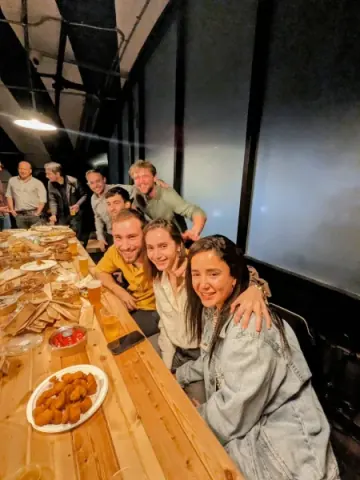
- Friday dinners, every week. The steady beat that everything else hangs off. Long communal tables, home cooking, and a room that shifts a little each time.
- The chagim. Rosh Hashana, Yom Kippur, Sukkot, Chanukah, Purim and Pesach, plus Yom Hazikaron and Yom Ha’atzmaut back to back. These are the peaks of the year and the busiest nights on anyone’s calendar.
- Culture and music. Israeli musicians passing through on tour, film screenings, talks, stand-up in Hebrew, evenings built around a book or an idea.
- Pitch and networking nights. Founders, operators and people who are hiring, in one room.
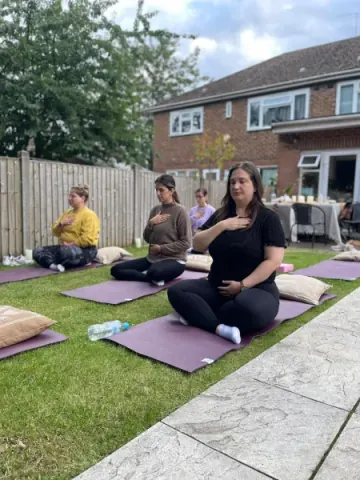
- Park picnics and daytime meetups. When the weather allows it, a large part of the calendar moves outdoors, to Hampstead Heath, Regent’s Park and the commons.
- Museum and gallery meetups. The big London museums are free, which makes them one of the easiest and cheapest ways for a group to gather.
- Socials for the twenties and thirties crowd. Drinks, hikes and dinners.
- Family and kids events. Holiday craft afternoons, family picnics and days shaped so that parents get to talk while the children run around.
Friday night is the fixed point
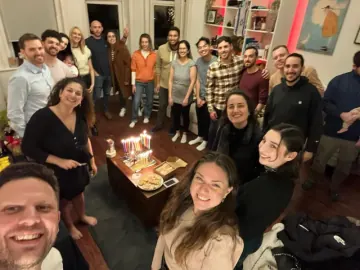
If you only ever go to one kind of thing, make it this one. Friday night dinner is the one event that repeats every week regardless of what else is happening, which means you are never more than a few days from the next chance to walk in.
The format is deliberately simple: a long table that keeps getting extended, home cooking rather than catering, a lot of Hebrew, and a lot of laughing. It is an evening to slow down, eat well and connect with the community and the tradition behind it. Turning up is the whole of it, and most of the people who are regulars now arrived the first time knowing nobody in the room.

The chagim are the peaks of the year
The holidays are where the calendar gets loud, and they are also where being far from home is felt most sharply. A holiday arrives, the street outside carries on as normal, and the whole rhythm you grew up inside belongs suddenly to you alone.
So the community holds the full round of them, the Israeli and Jewish holidays marked as cultural gatherings. A Yom Hazikaron ceremony in Hebrew and then Yom Ha’atzmaut the following evening, in the right order, the way the two are felt at home. Chanukah candles against the early dark. Purim as the party of the year. Seder tables that stretch to fit whoever has nowhere else to sit. These are the biggest nights on any Jewish calendar in London, and they are also the easiest ones to arrive at alone, because half the room is doing the same.
Culture, work and the rest of the week
Between the weekly dinner and the holidays sits everything else, and this is the part most guides miss.
Israeli artists tour, and when a musician or a comedian comes through London the gigs get shared through community channels. Film nights and talks run through the year. On the working side, pitch nights and professional meetups bring founders, engineers and operators into one room, and they are as much a social scene as a business one, which is why the young professionals crowd tends to live there.
Then there is the daytime calendar, which is quietly the friendliest of the lot. Picnics on the Heath, a walk, a coffee, a wander round a museum with a group. Nobody has to be at their most sociable at two in the afternoon, and that makes a first outing easier.
Who runs what in London
Being useful here means naming more than ourselves, so here is the honest map.
- HBayit. Our own calendar is built around Israelis in London, mostly in Hebrew, organised into five communities so that you land somewhere that fits: young professionals, tech and business, students, young families and new mothers. Friday dinners, the chagim, socials, family days. Free to join, and a registered charity (no. 1217670).
- JW3. The Jewish community centre on Finchley Road, a full cultural venue with a cinema, a café, classes and a public programme that runs all year. It is aimed at the wider UK Jewish community and runs mostly in English.
- Synagogues. Many run open social and cultural programmes alongside the services: lectures, quiz nights, community meals, kids’ activities. Worth knowing they exist, and that they are open to the whole community.
- Student societies. Most universities have a Jewish society. For anyone studying here, campus is the fastest way in.
- Informal groups. Meetup and Facebook carry the smaller things. Quality varies wildly, nobody is checking whether a listing is still accurate, and plenty of what is posted has already happened. Check the date of the last actual event before you build an evening around a group.
- Wider social groups and meetups. Beyond any single organisation, London has interest-based circles for food, running, cycling and culture, which are often the gentlest front door of all if a dinner table feels like a lot.
How to find out what is on
Two things, and only two things, are worth bookmarking.
The first is the events calendar. Everything we run goes up there, with the details, the address and the RSVP, and it is the one surface that is always current. If you want to know what is on in London next week, that is the page.
The second is the WhatsApp community, which is where things get shared first, and where the smaller and more last-minute gatherings live. Everyone joins through Ari personally rather than through a public invite link, so it stays a real community rather than a broadcast channel. One message and you are in.
What events cost
Most of the calendar is free or close to it. Friday dinners and community gatherings are free or run on a small contribution towards the food. The larger holiday events, the ones with a hired venue and proper catering, carry a ticket, and it is generally in the low tens of pounds. Family days are priced so that bringing the whole family is not a decision.
There is no membership, no joining fee and no application. Where an event is ticketed, the ticket goes through the events calendar, which is also the simplest way to check the price before you commit to anything.
Coming on your own, and which one to start with
Almost everybody arrives alone the first time, which makes it far more ordinary than it feels from the outside. A few things make it easier: come near the start, while the room is still forming rather than settled into clusters, and tell one person it is your first time. That single sentence hands everyone around you an easy way to fold you in, and someone usually does.
As for which event to pick, start with the one that matches the life you are actually living:
- Just arrived. A Friday dinner. It repeats every week, it is communal by design, and it is the shortest route from landing in London to knowing faces.
- Studying here. Campus first, then the community’s own student events.
- Working, twenties or thirties. The professional and social evenings.
- With small children. A family day or a holiday afternoon, where the children’s activity is also how the parents meet.
- Here for years already. The chagim. Even people who have been in London a decade tend to find that the holidays are the ones they do not want to spend alone.
Pick one, look it up on the calendar, and come. The second time, you will already recognise somebody.
Common questions
What Jewish events are on in London?
More than most people expect. The steady pattern is weekly Friday night dinners, the full holiday calendar from Rosh Hashana through Chanukah, Purim and Pesach plus Yom Hazikaron and Yom Ha'atzmaut, and around those, culture and music nights, talks, pitch and networking evenings, park picnics, museum meetups, socials for people in their twenties and thirties, and family days built around the children. HBayit runs more than 150 events a year on its own, and the wider scene adds plenty more. The events calendar on Luma is the quickest way to see what is coming up next.
Are Jewish and Israeli events in London religious?
A Friday dinner is home cooking, a long table and a chance to slow down together at the end of the week, and the holidays are marked as community gatherings. Synagogue-run events appear across the wider London listings too and are usually described clearly as what they are, so you know what you are booking.
Do I need to know anyone to come to an event?
No, and most people arrive on their own the first time. The formats are built for it, with communal tables and someone to greet you at the door. Telling one person it is your first time is usually all it takes. The second event is the one where it clicks, because the same faces keep coming back.
How much do Jewish events in London cost?
Most are free or close to it. Community gatherings and Friday dinners are free or a small contribution towards the food. Larger holiday events, the ones with a hired venue and catering, carry a ticket that is usually in the low tens of pounds, and family days are priced so that a whole family can come. There is no membership and no joining fee. Where an event is ticketed, tickets go through the events calendar on Luma.
How do I find out what Israeli events are on in London?
Two places. The events calendar on Luma is the live listing, always current, and it is where RSVPs and tickets happen. The WhatsApp community is where things get shared first, including the smaller and more last-minute gatherings that never make a public list. Joining is free and goes through Ari, so one message puts you on the list.